Door design, particularly for new concept vehicles, can be challenging when it comes to ensuring the performance and quality of the final product. Engineers strive to achieve the desired “quality feel”—a characteristic that is pursued by virtually every automotive manufacturer. The fundamental contributors to this quality perception are established during the design phase. These include elements such as the door’s size, weight, shape, and overall architecture. The real challenge begins when designing the components that ultimately define the user’s perception of quality. Many of the performance objectives originate from the driving experience, such as sound transmission, wind noise, and acoustic isolation. At the same time, these objectives can be in conflict with requirements related to ease of operation and user comfort. Finding the right balance between these competing requirements is therefore critical. The resulting compromises often constrain the design to a relatively narrow range in which the desired level of quality can be achieved.
Priority to User Experience
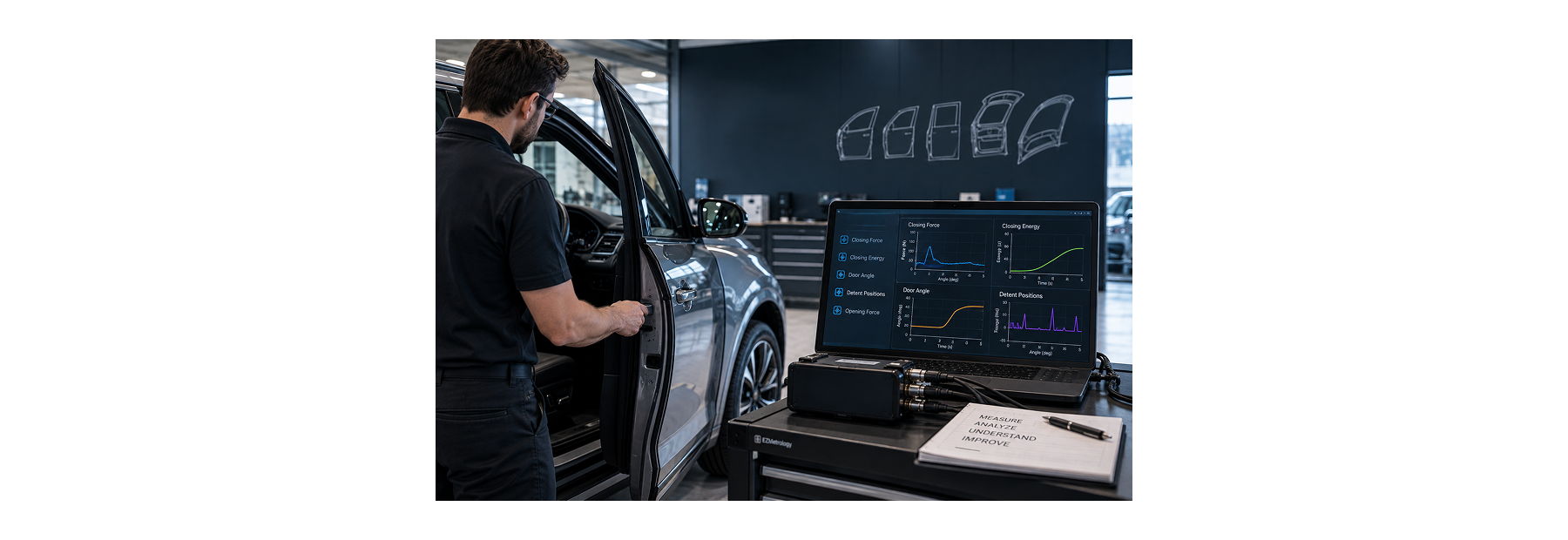
The foundation of door quality is defined by a set of metrics that are directly related to the user experience. These may include operating forces, the energy required by the user to close the door, door angles, and detent positions. Together, these parameters can be considered the “DNA” of a door—a set of characteristics that reflects and reinforces the identity of a particular brand. Ideally, this quality template can be applied across all doors within the brand, creating a consistent and recognizable signature “feel”. EZMetrology technology combines dedicated sensors with advanced algorithms to objectively measure and extract these key parameters. The resulting characteristic values can be established from a variety of sources, including workshops, competitive benchmarking, legal requirements, or other defined targets and specifications.
Examples of User Metrics
Minimum Closing Energy from any detent position
Minimum Closing Speed
Detent angles
Opening Force
Closing Force
Attention to Design Metrics
While door geometry, weight, and cabin size are largely fixed by the overall vehicle design, the next challenge is to engineer the individual components so that their placement and specifications work together to produce the desired overall door response. This requires a careful balance of component design, positioning, and tolerancing. Key factors include hinge inclination, door check design, striker positioning, and allowable tolerances. Together, these elements determine how the door behaves during opening and closing and, ultimately, how the user perceives its quality and performance.
Examples of User Metrics
Hinge tip
Door Check Profile
Seal Concept
Simulation or Experience
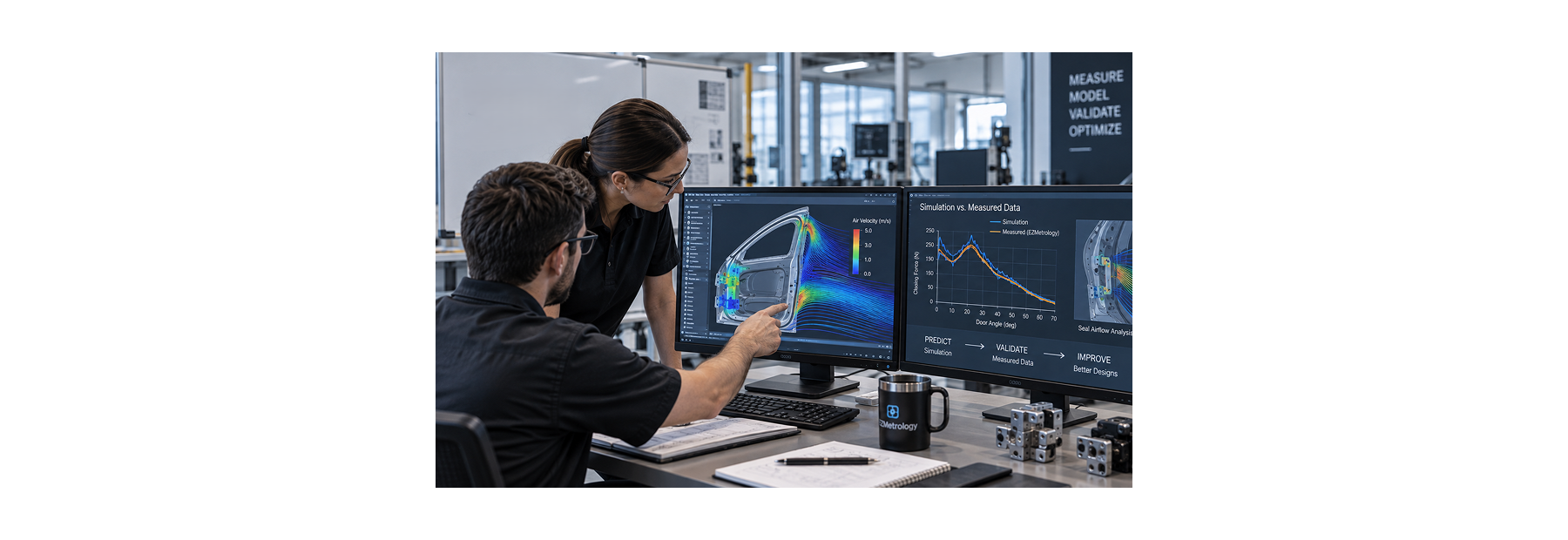
An effective door design process requires a combination of simulation and knowledge gained from previous designs. Simulation technology has advanced significantly and has become an invaluable tool for predicting and optimizing door performance. However, certain phenomena remain extremely difficult to model accurately, such as cabin air extraction and, in particular, the airflow behavior through the door sealing system. This creates a need to complement simulation with reliable empirical data. Successful simulation models can be significantly strengthened by incorporating experience-based data from existing vehicle programs. Ideally, this data is obtained from comparable vehicles that have undergone detailed measurement using EZMetrology door measurement technology. By combining simulation with measured data from proven designs, engineers can reduce uncertainty, improve prediction accuracy, and make more informed design decisions earlier in the development process.
Tool Kit
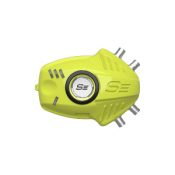
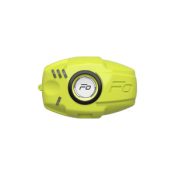
Within the scope of these challenges, EZMetrology technologies provide the tools needed to address each of these requirements. EZSlam, with its ability to determine the “DNA” of a door system, provides an excellent platform for collecting benchmark data that can be used as an input to simulation models. Its detailed, dynamic analysis of energy consumption across the individual door system components creates an effective closed loop between physical measurement and simulation. This enables engineers to compare predicted performance with measured results, identify discrepancies, and continuously refine the simulation model. When larger sample sizes or periodic measurements are required, the EZMetrology Pod family provides an efficient solution for performing targeted spot checks throughout the vehicle’s full life cycle. This allows the door system to be monitored beyond the initial development phase and helps ensure that the desired quality characteristics are maintained from development through production and vehicle use.