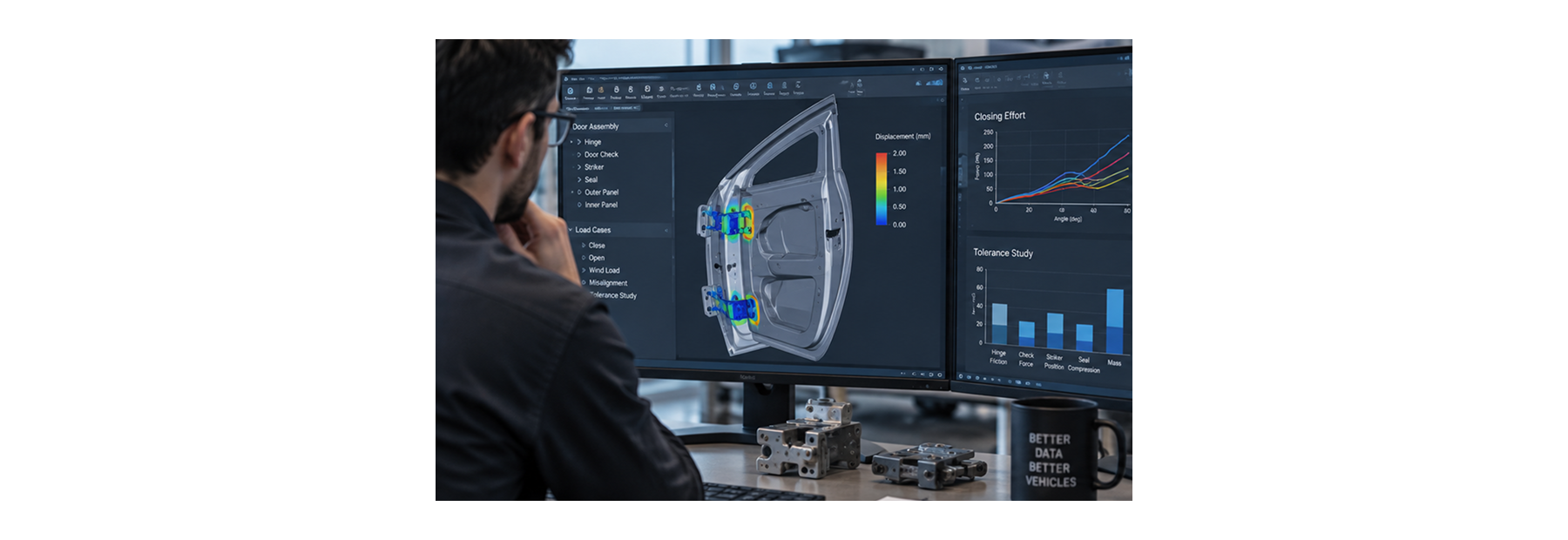
A design developed in a CAD environment always performs as intended at nominal conditions. However, production processes inevitably introduce tolerances and variations. Understanding the sensitivity of the overall system to individual subassemblies, and identifying which tolerances are critical to the final outcome, is therefore an essential part of the design strategy. The relationship between a component tolerance and its impact on overall door performance is often non-linear, difficult to predict, and not always intuitive. Small variations in one component can have a disproportionate effect on the final system behavior.
What is the contribution of hinge friction tolerance to the overall door closing effort?
And how does this contribution interact with the tolerances of the other components in the system? Understanding these relationships is key to establishing realistic and robust tolerance specifications.
Simulation
Simulation of component variations is one of the most efficient ways to establish tolerances and understand their respective sensitivities. By modeling different combinations of component characteristics and tolerances, engineers can predict how variations will influence overall door performance. However, while this approach is highly valuable, the accuracy of any simulation is fundamentally dependent on the quality of the model and the data used to build it. If the underlying assumptions do not accurately represent the physical system, the predicted effects of variation may also be inaccurate. Simulation therefore requires reliable real-world data to establish a meaningful connection between the virtual model and actual vehicle behavior.
Data Collection
The most effective way to improve simulation accuracy is to provide it with representative physical data. The EZMetrology toolkit enables engineers to establish the baseline performance, measure real-world variations, and quantify their effect on the final outcome. In other words, the system provides a structured way to collect, analyze, and document the data required to understand the behavior of the door system. This wealth of measured information can then be used to tune and validate simulation models. Once the relationships between tolerances and performance are understood, tolerances can be defined with realistic objectives, and the resulting system performance can be maintained within the desired range.
Variations and Tolerances
Once the relevant parameters can be measured, controlled variations can be intentionally introduced to the system. EZMetrology technologies can then quantify the resulting changes in door performance, including increases or decreases in operating and closing energy. This creates a direct relationship between individual component variations and their contribution to overall system behavior. By systematically collecting this information, engineers can build a deeper understanding of the sensitivity of each component and tolerance. The resulting data not only improves the accuracy of the current simulation model but also creates a valuable knowledge base for future vehicle programs. In this way, measurement and simulation become part of a continuous learning loop: design → simulate → measure → validate → optimize.